
For any display calibration, a probe is required for display measurements, from which the final 3D LUT based calibration is generated.
And it is the accuracy of the probe measurements that defines the final calibration accuracy achievable, regardless of the actual accuracy of the calibration system used, which is why high-end calibration requires high-end probes.
Probe Colour Accuracy
Most calibrators understand that if a probe is inaccurate any resulting calibration will also be inaccurate. The probe used for calibration really does define the ultimate level of colour accuracy that can be attained.
And unfortunately, some probes are far worse than others.
The following shows a direct comparison between a well known monitor manufacturer's in-built probe, and an i1D3 using a Corr. File generated on the same monitor with a CR-250 4nm Spectro.
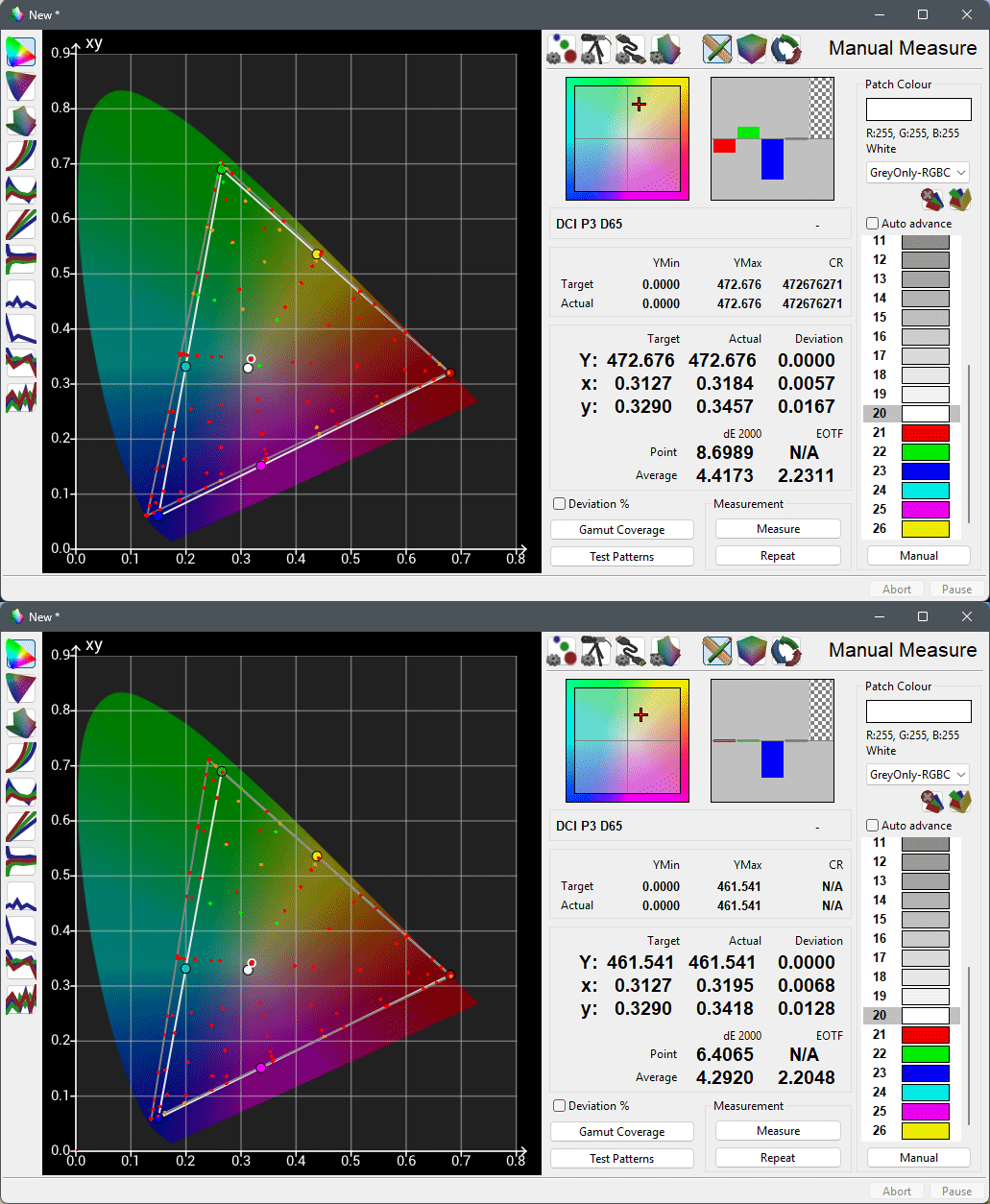
As can be seen, the error is significant.
The i1D3 and Corr. File has been chosen as the comparison, as that is the minimum most users should be using for basic level calibration, although as the Corr. File will not normally be generated on the actual monitor in use, there is still room for error, as the ? CORRELATION FILE ACCURACY modal window example shows within the i1Display Pro/Calibrite page.
Note: Corr. File accuracy can be improved by converting the Corr. File into a Reference Probe Match file via the SPD2Matrix app, as described in the Addons page, assuming the Corr. File really is suitable for your specific displays, as SPD2Matrix will also show you.
Polarisation Errors
Another potential issue with probes are Polarisation Errors, with measurement values changing with probe orientation on displays that use Polarisation filters. The following are two measurement sets made with the same probe measuring the same exact spot on a monitor, with just a 90° rotation of the probe.

As can be seen, errors can be significant
Invest In Good Probes
Investing in good probes really is a necessity for colour accurate calibration.
And this is a key reason for Probe Matching, using a Spectrometer to improve the accuracy of a colourimeter being used for display profiling.
However, it is also often assumed that while an inaccurate probe will generate inaccurate calibration results, verification of the final calibration using the same inaccurate probe will technically report an accurate calibration, as the same probe inaccuracy will be included within the verification as with the original profiling, and as the 3D LUT was generated using measurement data from the same probe, all will cancel out...
This assumption is not correct.
Inaccurate Calibration & Verification?
When using any probe that is not accurate, the measurement data provided for LUT generation via ColourSpace is obviously therefore inaccurate, and so the final calibration LUT will be inaccurate compared to the same calibration performed with an accurate probe.
That is a basic fact, and is easily understandable.
However, what is often overlooked is that when the LUT is applied and verified the verification measurements will also show calibration inaccuracy, even though the LUT calibration is being verified with the same probe, with the same measurement errors.
It is assumed that even though the probe used was inaccurate, verification of the 3D LUT calibration will measure accurate results, as the same probe, with the same inaccuracies, is being used, and therefore any measurement errors in the verification will be down to poor calibration results from the 3D LUT generation.
As stated above, this assumption is incorrect!
The inaccurate verification is not showing the 3D LUT generation has been performed incorrectly or badly, but, as the original measured values were inaccurate the generated LUT will have inaccurate correction values, plus the probe will again be reading the verification colours inaccurately.
The inaccurate verification is telling you that there is a problem with the probe's accuracy...
The use of Probe Matching to a Spectro is always recommended, using ColourSpace's unique probe matching capabilities
Probe Accuracy Error
The following is an example of errors introduced into a LUT based calibration, using a deliberately inaccurate Probe Matching matrix with an i1D3 probe, and a Grey Ramp RGB Quick Profile.
Accurate Probe
The first graphs show an initial profile of a wide gamut display, and the verification of a Rec709 calibration. As can be seen, the verification shows a relatively accurate calibration result (especially for a Quick Profile).


Inaccurate Probe
The following graphs show an initial profile of the same wide gamut display, this time with a deliberately inaccurate Probe Match enabled. The verification of a Rec709 calibration, using the same probes match settings, show the result as being inaccurate - due to the original probe measurements being inaccurate.
(The Probe Match introduced a simple -0.02 x offset into Green only.)
As can be seen in the Verification graph, the Red primary shows an obvious error, with the Green primary showing a slightly smaller error.
Using the same inaccurate probe for verification and the original profiling doesn't cancel-out the original probe measurement errors.


Click the above graphs to directly compare to the Accurate Probe graphs above to see the deliberately introduced probe match error in the green measurement, and the inaccurate LUT verification caused by the inaccurate probe readings.
Accurate Calibration
The above shows the importance of using probes that accurately measure and profile the display being calibrated, and is why Probe Matching to an accurate Spectro is real necessity for calibration accuracy.
It is not enough to rely on manufacturer provided probe matrices or Correlation Files, as they are at best generic compromise settings, having not been generated on your specific display, as well as the need to know exactly what backlight technology your display actually uses. Unfortunately, most display manufacturers do not provided accurate information on the backlight used, and often change the technology without warning. Further, such correction files apply a relative correction to the i1D3's underlying factory calibration, not an absolute correction. It is always best to verify any Corr. File via SPD2Matrix for suitability on your specific display.
The problems with relying on Correlation Files (EDRs) for i1D3 probe can be seen on the i1Display Pro/Calibrite page.
Probe matching to a good Spectro is the only viable option for display calibration accuracy.
Wide Gamut Displays
Calibration of wide gamut displays has become ever more demanding, with the use if very narrow spectral bandwidth RGB panels and laser projection to enable the required P3 and Rec2020 gamuts to be reached.
There are multiple potential issues with wide gamut displays, but for calibration one of the most obvious is Probe Accuracy,
Most calibrators understand that if a probe is inaccurate any resulting calibration will also be inaccurate. And this is a key reason for Probe Matching, using a Spectrometer to improve the accuracy of a colourimeter being used for display profiling.
However, it is also often assumed that while an inaccurate probe will generate inaccurate calibration results, verification of the final calibration using the same inaccurate probe will technically report an accurate calibration, as the same probe inaccuracy will be included within the verification as with the original profiling, and as the 3D LUT was generated using measurement data from the same probe, all will cancel out...
This assumption is not correct.


